Tuesday, June 30, 2009

Let's Learn about Korea on Tuesday-Lesson #29

There are 2 very popular children's characters in South Korea. One of them is very cute, the other is kind of gross.

Pororo/Poong-Poongie
First let's start with the cute, Pororo the Penguin. He lives in Antarctica and has all sorts of adventures with his friends. Pororo and his group are pictured below: Poby the polar bear, Loopy the beaver, Harry the hummingbird, Crong the dinosaur, Petty the penguin, and Eddy the fox. This a very popular cartoon shown all over the world.


Now for the gross, Poong-Poongie. He is an orange stuffed animal that has a unique, um, 'talent.' When you squeeze him, he lets out a fart noise! Ewwwwww! I guess this doll is everywhere in South Korea and babies and toddlers love it.

Friday, June 26, 2009

Lesson Book is Totally Ready!

I got my copy of my "Let's Learn about Korea" lesson book, and I'm thrilled with how my little (8x8) book came out! I worked really hard on it and I'm very proud of the final result. I made the book for Gabe and my family, but I hope it's something you can enjoy as well. If you'd like a copy, click HERE to order one. I've also added the link to the sidebar.

Thanks again for all your support and encouragement about the lessons. I loved writing them, but I'm glad you felt that you got something out of them as well. A shout-out goes to my mom and Dave who helped me edit it.

Tuesday, June 23, 2009

Let's Learn about Korea on Tuesday-Lesson #28

We have Thanksgiving in the United States, and Korea has a similar holiday known as Chuseok.

Chuseok
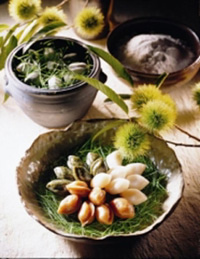
Chuseok is a harvest festival that is celebrated in late September/early October, depending on the lunar calendar. This year it falls on October 3. South Koreans return to their hometowns and share a traditional feast with their family. One of the most popular dishes served on Chuseok is songpyeon which is small rice cakes with sesame paste, chestnuts and pine needles. It is pictured below:

Food is not the only component of Chuseok; honoring ancestors is also very important. Koreans attend memorial services and visit the graves of their ancestors. They weed and clean up the grave area and also offer thanks to their ancestors for all their abundance and good fortune.

Saturday, June 20, 2009

Half Way Home

Today marks 2 months of waiting for Gabe to come home. After looking over other people's timelines, it seems most people travel 16-18 weeks after referral. IF (and that's a big IF*) we fit in the average, we are at roughly the half way point. Let's pat ourselves on the back for being patient thus far, and start to focus on the next 8-10 weeks when (hopefully) we'll be packing our bags for Seoul!!

*For those of you interested in the paperwork side of things, we are still waiting on DCFS' second endorsement letter. While it's true that they approved us in December, in Illinois you need DCFS to approve you TWICE (once before referral and once after). It usually takes about 3-4 weeks for this letter, we are over 5 weeks. Only ONE person does the approvals and she has been out sick. Let's hope the DCFS lady is drinking lots of liquids, taking vitamin C and has her 'approval hat' on when she returns!

Thursday, June 18, 2009

Need a New Laptop?

Who doesn't, really? One of my bloggy/adoption friends is raffling off a MacBook. That is a pretty cool prize...
Check it out at Baby J's MacBook Giveaway, entries are $5.00. I bought 5 tickets myself.

Good Luck!

Tuesday, June 16, 2009

Let's Learn about Korea on Tuesday-Lesson #27

Today's lesson is on the city that Gabe was born, Jinju.

Jinju
Jinju is a smaller city located in the South Gyeongsang province of South Korea, about 5 hours southeast of Seoul. Jinju is known for its high quality silk and supplies 70% of SK's silk. As with most cities, there is a unique food, too, the Jinju version of bibimbap uses raw beef.
The city, though is best known as the site of major battles during the Japanese invasion of 1592-93. During the invasion Korean soldiers sent floating lamplights on the water to send signals to other troops to prevent the Japanese forces from crossing the river in secret. Now, every October for 10 days, there is the Jinju Namgang Lantern Festival or Floating Lantern Festival, which commemorates the troops who died for their country defending Jinju from the Japanese forces. Here is a picture of the festival:

Friday, June 12, 2009

The Fate of the Lessons

I know some of you are wondering what the future holds for the "Let's Learn about Korea on Tuesday" lessons now that we're on the path to bring Gabe home. The bad news is...the last one will be July 14, Lesson #31. The good news is...you can have your very own hard copy of all the lessons!

I mentioned before how I was making a book of the lessons for myself. Well, I've gotten a few emails from people wanting to buy a copy for themselves. I've tweaked some of the posts slightly by taking out some personal info, but for the most part the book is all my lessons (including the next 5 lessons) as you know them. I ordered my copy a few days ago (soft cover) and I should get it in about 2 weeks. When I get my copy, I will make sure there is nothing goofy and it looks totally perfect, and I will let you all know. If you'd like to order a copy now, or just want to take a peek...head on over to Blurb.

Thanks for all your support and encouragement!

Wednesday, June 10, 2009

Happy 7 months to Gabe!

I'm sure you are...

Giggling

Crawling

Teething

Happy

Smiling

Eating

Cuddling

Splashing

Loved

Mommy and daddy can't wait to enjoy all of this with you very soon!

Tuesday, June 9, 2009

Let's Learn about Korea on Tuesday-Lesson #26

Many countries have a distinct, native liquor or alcohol. For instance Greece has Ouzo, Denmark has Aquavit, Mexico has Tequila and Korea has Soju.

Soju
Soju is one of the most popular alcoholic beverages in Korea. It is clear in color, made from rice, and has a similar, though slightly sweeter taste, as vodka. Jinro is the largest producer and most popular brand of Soju. There are a few things you should know about drinking Soju in Korea. One should only drink it with others while at a meal. Soju is usually served in a shot glass and it should only be filled by someone else only when the glass is empty. Following this etiquette promotes camaraderie among friends and business associates.


Cheers! or Gun Bae!

Friday, June 5, 2009

Usually LBOS is all about rainbows, hugs and puppies...but there is something not so sweet (and that's putting it very mildly) that you should be aware of. It is the HORRIBLE movie Orphan coming out that has the adoption community fired up, and rightfully so. My friend Cori has written a perfect post about why it's so bad and what you can do about it.
Thanks Cori!

Thursday, June 4, 2009

Some Fun Facts about Gabe

I know you are probably wanting to know more about our little guy. Here are a few tidbits to tide you over:

  • He goes to bed at midnight (!) and sleeps until 8am, with 2-2hour naps a day. I'm glad Dave is already on the late shift in our house. Gabe does sleep with his foster mother which is very common (as is a late bed time) in Korea.
  • He was born at 6:35 pm on Monday, November 10. He shares his birthday with Dave's late great-aunt Libby, who, from what I understand, was a wonderful caring woman who was very special to my mother-in-law. He is Scorpio born in the year of the Rat.
  • Gabe's in the 50th percentile for his height, 75th for his weight, and 60th for his head, according to the growth chart for Korean boys. If he continues on the growth path he's on, he'll probably be 22-24lbs and about 30inches long when he comes home.
  • His foster mother is 57 and married with 2 grown children. Gabe is her 2nd foster child. She is described as active, cheerful and tidy with a well-lit and well-organized home...all good for a baby. We have a picture of her and she looks like a lovely woman.

Tuesday, June 2, 2009

Let's Learn about Korea on Tuesday-Lesson #25

Celebrating a child's first birthday in Korea is a major event. The celebration is called Toljabee or Tol.

Tol
In the olden days in Korea, before medical advancement, children often died before their first birthday. Once a child hit 12months, the survival rate was much higher, so this milestone became worthy of a big party. There are four major components to a Tol celebration: 1) praying and giving thanks 2) wearing special birthday clothes, usually a hanbok 3) having a special table and practicing the Toljabee 4) sharing food and drink with family and friends.
All four elements are important but the most unique is the Tol table and performing the Toljabee. The table includes fruits, rice cakes, candy towers and other foods but also includes items that predict the child's future.


The items are moved to a smaller table and the birthday boy or girl sits and chooses items that interest them. Some of the traditional items on the table include: bow and arrow=the child will become a warrior, thread=the child will live long, book or pencil=the child will become a successful scholar, money=the child will become rich, ruler=the child will be talented with his/her hands, spoon=the child will be a good cook. Many parents add more modern and personal items on the table.

We are planning on having a Tol celebration for Gabe in November. Maybe we should include a guitar on the table for our little rock star?